

Summary
Samsung SDS
CSP & IT Services
NPUaaS — instance family NPU-RNGD-1 (1/2/4/8-card)
Virtualized NXT RNGD Servers, Dongtan IDC
collaboration start to commercial launch
10 mo
commercial NPUaaS from a domestic CSP
1st
PUE class, free-air-cooled Dongtan IDC
1.12
Samsung SDS operates Samsung Cloud Platform (SCP), offering GPUaaS alongside a growing set of accelerator options for enterprise and public-sector customers. Adding an NPU tier meant more than provisioning hardware — it meant absorbing RNGD into SCP's existing virtualization, storage, networking, and billing layers, so customers could consume it exactly like they consume GPU instances today.FuriosaAI drove the actual customer path — signup, VPC and subnet configuration, instance creation, SSH, driver verification — to find and fix friction before launch, then co-authored the incident runbook and delivery-verification process that now standardizes every RNGD rollout to SCP.
Challenge
Subscription Economics Under Pressure
Samsung SDS's problem wasn't a lack of AI infrastructure — it was subscription-business unit economics. Growing inference demand was pressuring GPUaaS margins through GPU pricing and power, while public and financial customers couldn't use foreign hyperscalers under sovereign-cloud rules, and domestic-hardware procurement demand was real but unserved.
What was needed wasn't just an accelerator — it was one that could actually be absorbed into SCP's virtualization, storage, networking, and billing layers, so customers could self-service it exactly like a GPU instance.
Solution
Absorbed Into SCP, Not Bolted On
FuriosaAI and Samsung SDS drove the actual provisioning path themselves — portal to SSH — to surface friction before customers hit it, then built the virtualization and operations layers needed for RNGD to behave like any other SCP resource.
Virtualization and Air-Cooled Density
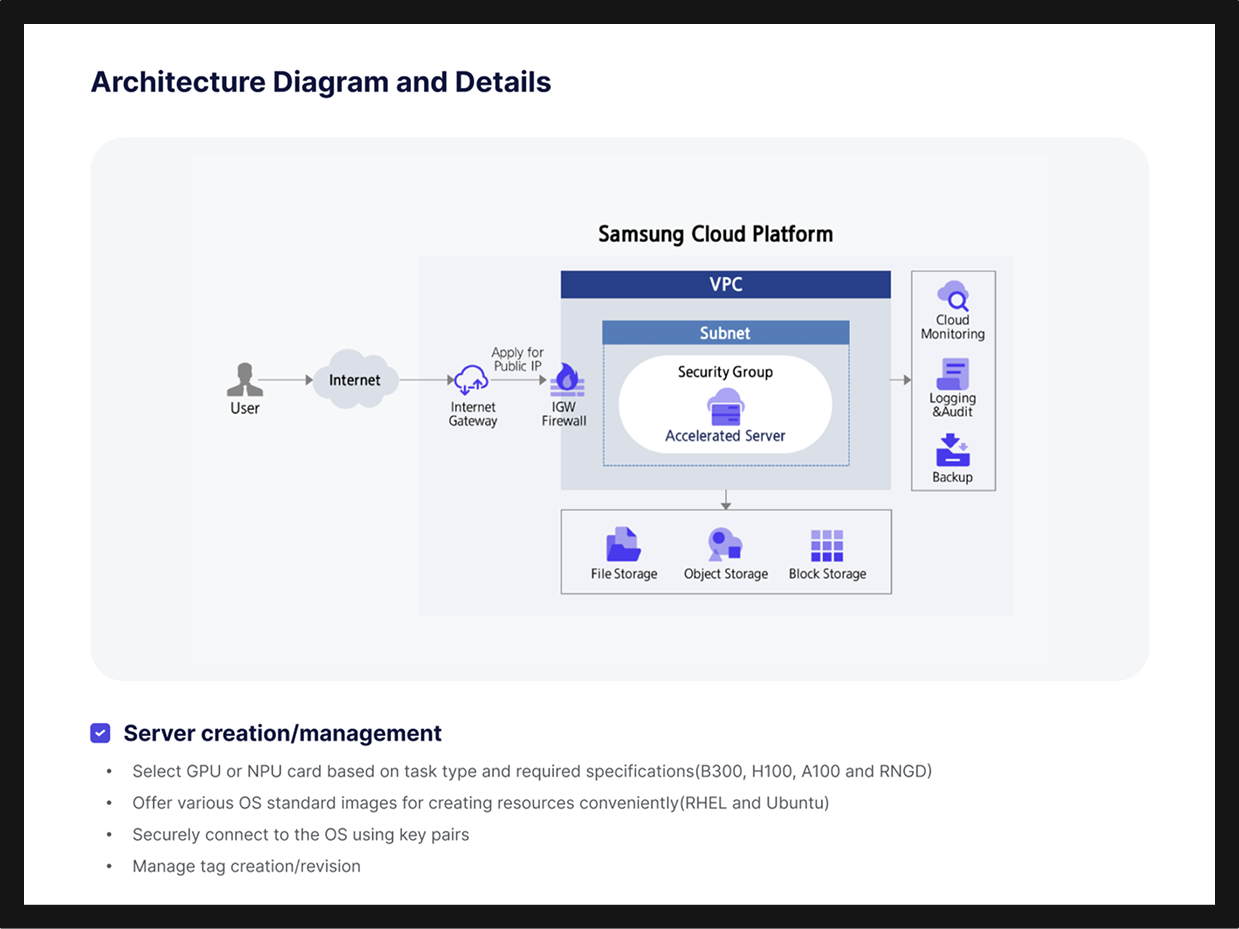
The NXT RNGD Server (8× RNGD, 4U, ~3kW) integrates into SCP's virtualization layer through NPU device passthrough. Console exposure is the NPU-RNGD-1 instance type, paired with the FRD (Furiosa Runtime & Driver) 2026.2.0 image, so customer VMs come up with the driver pre-configured. At ~3kW for 8 cards per server, that density fits inside Dongtan's free-air-cooled halls with no liquid-cooling retrofit — the 180W passive card is the precondition.
Provisioning Walkthrough and Joint Operations
FuriosaAI drove the actual customer path — SCP portal signup, VPC/Subnet/IGW/SG/Keypair, instance creation, NAT IP, SSH, FRD driver verification — and wrote two onboarding guides, surfacing non-technical friction (like the sales-approval gate before GPU/NPU resources provision) to fix jointly with SDS.
An incident runbook, co-authored with SDS, defines who does what within how many minutes; DC delivery verification is now a standardized process across all RNGD deliveries.
Target Workload
Multi-Tenant, Metered, On Demand
Economics
A Domestic Option Inside a Sovereign Cloud
July 20, 2026 marked Korea's first commercial NPUaaS from a domestic CSP — customers consume RNGD inference by subscription with no server purchase or build-out required.
That's a domestic accelerator option inside a sovereign cloud, opening public and financial procurement paths GPU-only offerings couldn't reach, operated alongside GPUaaS rather than replacing it. Collaboration start to commercial launch ran about 10 months: September 2025 start, H1 2026 virtualization and ops build-out, July 2026 launch.
Development
Three Tracks of Expansion
Capacity growth is underway from 2 servers, with expansion already in discussion. RNGD is also moving into PPP-based public AI services, and a third track bundles dedicated NPU services with selected models.
Joint ISV proof-of-concept-to-production path standardization is next, with expansion plans presented at the SDS event on September 3.
VISION
Inference by Subscription, Not by Build-Out
The deeper shift isn't adding a new instance type — it's proving a domestic accelerator can be consumed exactly like a GPU instance, inside the same virtualization, billing, and operations layers customers already trust.
That's what makes RNGD a sovereign-cloud option, not a sovereign-cloud exception.
