

Summary
Upstage
AI — Foundation Models
Solar Pro 3 (100B-class, 128K context, NVFP4)
3× NXT RNGD Server (Daum production)
power efficiency vs. H200
1.3×
scale-up requested post-launch
10×
context length in production
128K
Power Efficiency
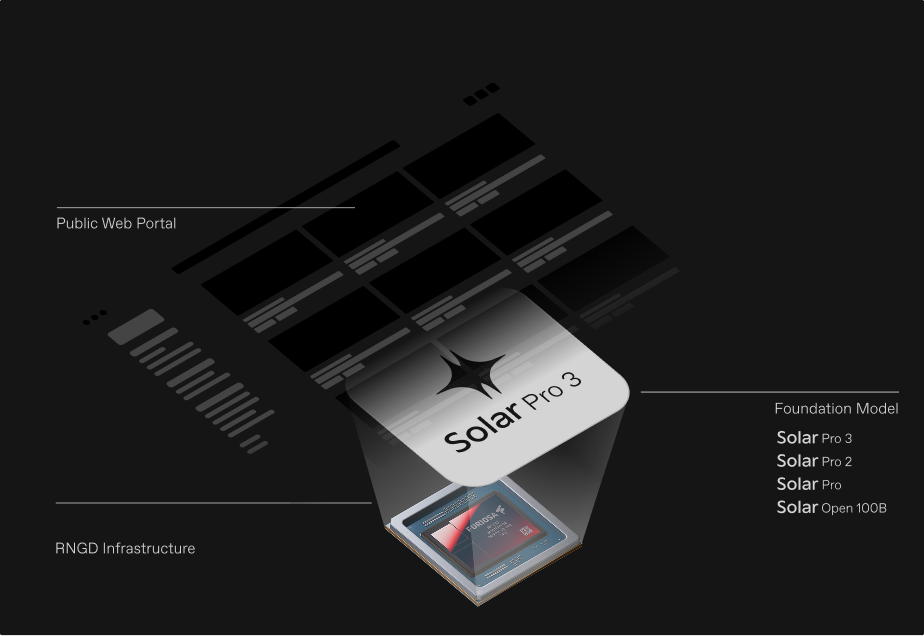
Upstage builds the Solar family of foundation models and serves them through its API and through partner products like Daum AI Summary, a search-result summarization feature on one of Korea's largest consumer portals. Expanding that footprint meant proving a 100B-class model — Solar Pro 3, at 128K context — could hold production quality and cost discipline on RNGD.FuriosaAI validated the serving configuration on furiosa-llm, shared an offline throughput profile before go-live so expected performance was agreed in advance, and exposed an OpenAI-compatible endpoint so Upstage's application integrated by changing only the endpoint URL.
Challenge
Can a 100B-Class Model Hold Production Quality at 128K?
Inference cost is COGS for a foundation-model company. Expanding Solar's API and service footprint required an alternative to H200 serving economics, and the "Korean full stack" position — domestic model plus domestic silicon — is a real differentiator in public-sector and enterprise deals.
The technical gate was concrete: can a 100B-class model at 128K context be served at production quality, on infrastructure Upstage could stand behind for a consumer-scale portal?
Solution
128K Context, Weights Compressed to Make Room for KV Cache
Solar Pro 3's 100B-class weights compress to NVFP4 to fit TP=4 within the 48GB-HBM3-per-card budget — freeing headroom that gets allocated to the real bottleneck at 128K context: KV cache.
Quantization, Memory, and Serving Topology
100B-class weights compress to NVFP4 to fit TP=4 (4 cards) within the 48GB-HBM3-per-card budget. One 8-card server runs as TP=4 × DP=2 — two model replicas for throughput scaling plus per-instance fault isolation. Validation was shared as an offline-throughput profile (CSV) on furiosa-llm 2026.3.0rc3 before go-live, so expected performance was agreed in advance.
API Compatibility and SDK Co-Optimization
An OpenAI-compatible /v1/chat/completions endpoint is exposed as-is — Upstage's application integrates by changing only the endpoint URL, with reasoning-content format and usage fields (including cached_tokens) verified compatible.
Solar Pro 3 entered SDK 2026.4's performance-optimization targets, so each SDK release flows directly into service performance; Solar Embedding is newly supported, and a Solar Mini 4 lightweight variant is targeted for late-August integration.
Target Workload
API Serving and Portal-Scale Summarization
Economics
Production Traffic, Then a 10× Scale-Up Request
Commercial traffic from one of Korea's largest consumer portals now runs on a domestic model plus domestic NPU — validation well beyond a proof of concept, measured at roughly 1.3× power efficiency versus H200.
After operational stabilization, Upstage requested a 10× scale-up — entering capacity planning is itself the quantitative trust signal. Additional server allocation (3–4 units) is being evaluated against traffic growth.
Development
Built for the 24-Hour Power Curve
Portal traffic spends long periods at low load, and RNGD's low-load power behavior — low-100s of watts per card near idle — contributes materially to cumulative TCO. This workload is sold on the 24-hour power curve, not peak performance.
With 128K long-context requests mixed in, KV-pool management is the discipline: prefix-cache hit rate is tracked as an operations metric.
VISION
A Three-Party Model for the Korean AI Stack
Infrastructure, model, and application — presented together in a public joint webinar — is the story Upstage and FuriosaAI are building toward: a domestic full stack that doesn't ask customers to trade capability for sovereignty.
Day-N RNGD support for new Solar releases is now standing process, with parallel discussions underway on scaled serving through Samsung SDS's NPUaaS.
